
Are Aberdeen Giving Their Project Signings a Chance to Succeed?
Aberdeen's player-trading model depends on developing young talent. But are the foundations in place to make it work?

Today Aberdeen announced the departure of Kjartan Már Kjartansson to SK Brann as Stephen Robinson continues to reshape the squad ahead of the end of the transfer window.
The Icelandic midfielder arrived in the summer of 2025, and, having already racked up nearly 60 appearances and over 3,000 minutes of first-team football with Stjarnan, was billed as one of the next hot prospects.
At the time of signing, then manager Jimmy Thelin, said: “He is a very exciting talent, but we also know we need to work with him to develop further, and he will take time to adapt to a new club, a new league and a new country. We must be patient; we must nurture him and at times we must protect him to ensure we are able to realise his significant potential.”
Naturally, Dons fans were excited by the announcement given the club appeared to be attracting a player that had all the hallmarks of someone who was destined for a higher ceiling than Scottish football. Crucially, the 18-year-old perfectly fitted the mould of the player trading model that the club had openly said it was committed to.
So, one year later, with Kjartansson’s Dons career coming to a frivolous end having made just nine appearances - eight of those coming as a substitute - what happened?
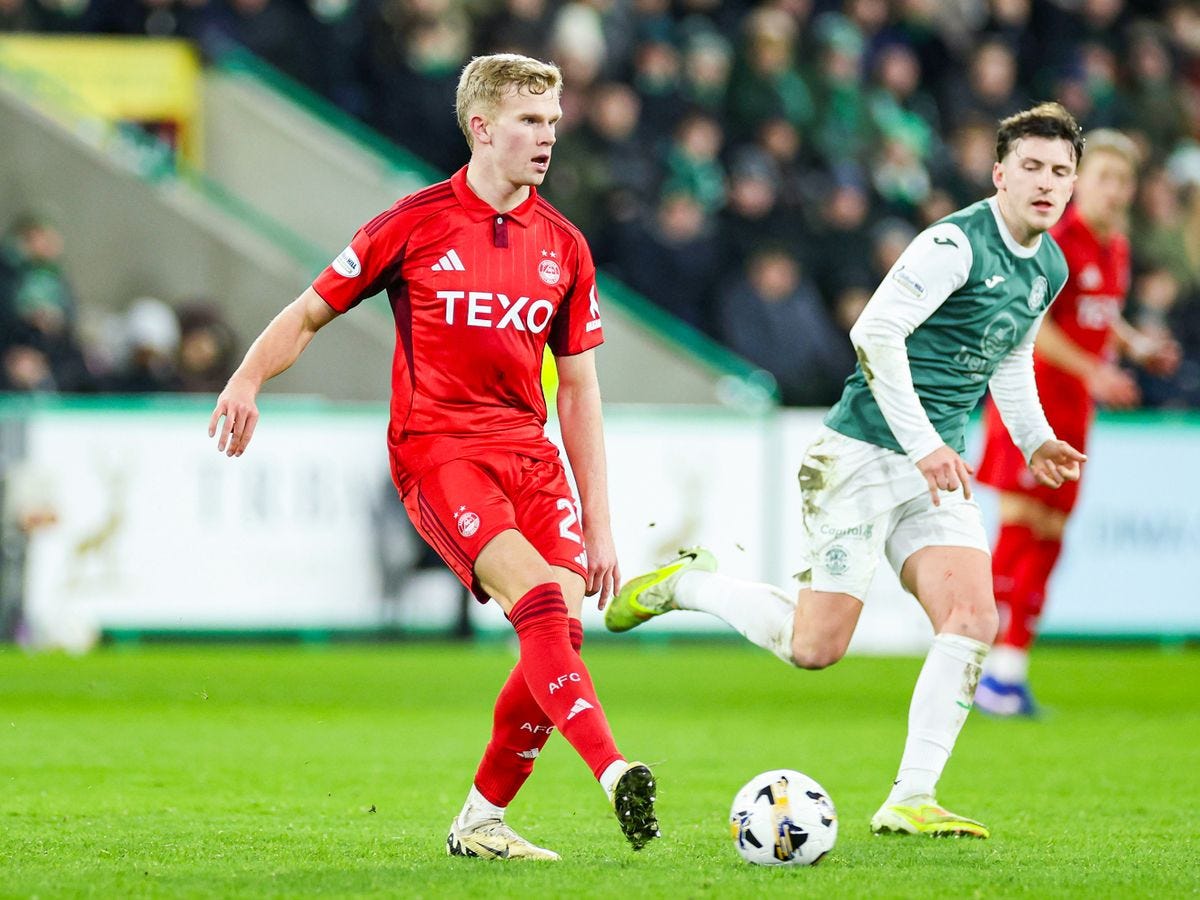
To understand why Kjartansson’s departure raises wider questions, we need to go back to 2023.
Following the impressive development and subsequent sales of players such as Scott McKenna, Lewis Ferguson and Calvin Ramsay, the club formally committed to a ‘player trading model’. The idea being that you recruit talented young players, develop them into first-team regulars and eventually sell them for a significant profit.
At first, this looked like an ingenious move. Under head of recruitment Darren Mowbray, Aberdeen demonstrated that the model could work, unearthing players such as Bojan Miovski, Duk and Ylber Ramadani. And then Mowbray departed for Southampton in the summer of 2023. Ever since, Aberdeen’s success in the transfer market feels like it has slumped, culminating in the now infamous summer of 2025. Changes were made as a result of that perplexing window, and Mowbray is now back in post once more.
However, for Mowbray to work some more of his magic, he will need the club to hold true to its word that there is a pathway for young, emerging talent to solidify a place in the starting XI on a weekly basis. Whether that remains the case, is very much in question.
In Kjartansson’s instance, there are a number of possible explanations for what seems like a premature exit from the club. Perhaps he struggled to settle in Scotland. Perhaps he failed to do enough in training to force his way into the starting XI. Perhaps he simply wasn’t good enough. But was he ever given a genuine opportunity to prove it? The evidence would suggest not. And he is far from the only player to find himself in that position.
Over the last three full league campaigns, the average percentage of minutes handed to Under-21 players by Aberdeen sits at just 6.6%. In comparison to other clubs who have competed in the Premiership during that period, Aberdeen sit 9th, with Hibs, Hearts, Livingston, Celtic and St Mirren all below the Dons.
Furthermore, when looking at the depth of opportunity, Aberdeen average approximately 729 minutes per Under-21 player utilised over the last three campaigns - a large proportion of these minutes coming in the way of Alfie Dorrington and Connor Barron. This equates to a meager eight full matches across three years, reinforcing the perception that many of these outings are fleeting rather than a meaningful, sustained introduction to the first-team fold.
Concerningly, St Mirren, under the stewardship of Stephen Robinson at the time, rank bottom across both of those metrics, with an alarming average of only 1.8% of minutes given to Under-21 players over the last three full league seasons.
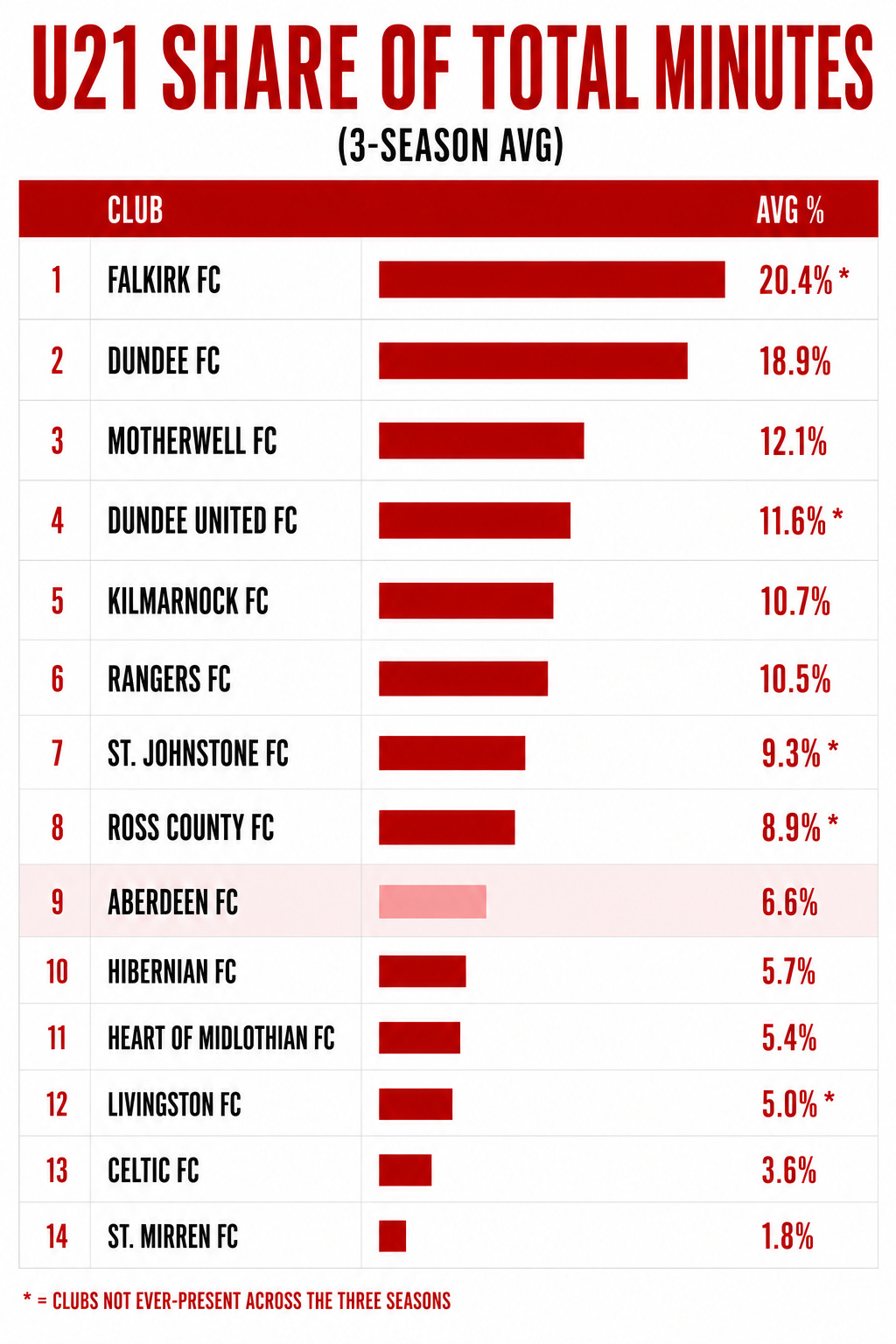
While the stats for Aberdeen are not chronic in comparison to other Scottish clubs, it’s been well documented that the minutes being given to young players in Scotland is far from acceptable when compared to other nations. Cormack has spoken previously about aspiring to the gold standard of FC Nordsjælland in Denmark and now even has David Lawrie, the Danish club’s former chief operating officer of five years, on the Aberdeen board as a non-executive director. For comparison, Nordsjælland rank No.1 across the top 55 leagues in the world for game time given to players under the age of 21 at a staggering 44.7% of minutes. It’s no coincidence that they are now dubbed as the ‘most profitable club you’ve never heard of’, raking in over €230 million in player sales over the past decade. The key to their success has been the bravery to give maximum exposure of first team football to their young starlets. Between April 2018 and March 2023, FC Nordsjælland gave 41 players under the age of 20 their professional debut, setting a new standard for youth integration in football.
Can Aberdeen truly say that they are giving the same opportunity to development signings and younger players to flourish? As part of the 2023 annual accounts report, Dave Cormack said: “This acquisition of emerging young players combined with continued, substantial investment in our youth academy to develop young, homegrown talent, gives our Club the best opportunity of success.” In 2024 he said: “Whilst winning both the Club Academy Scotland (CAS) Under-16 and Under-18 leagues last season demonstrates success, the key measure must be how many academy players make it to the first team. Our laser focus is now on how we develop first-team-ready players from the academy to deliver a return on our significant investment.” Of that Under-18 team who won the league, only Fletcher Boyd, Alfie Bavidge and Findlay Marshall have played any minutes of league action - a total of 138 minutes of first-team football combined.
Beyond the difficulty homegrown players face in breaking into the starting XI, the club’s development signings - brought in with the intention of future sales - are now also struggling to establish themselves as regular starters.
There is no doubt that Aberdeen want to be a club that provides ambitious young players with a platform to develop, and eventually take the next step in their careers, while simultaneously creating valuable transfer assets. It is a model that makes both sporting and financial sense. The question, however, is whether the environment currently exists to turn that ambition into reality. More specifically, have Aberdeen created a clear and reliable pathway that consistently transforms promising recruits into better footballers? At this moment in time, you would have to say no.
The upheaval at Aberdeen over recent years stands in stark contrast to the cohesion and consistency that young players need to develop and thrive. Almost every manager since Derek McInnes’ departure has found themselves under intense pressure following an extended run of poor results, creating an environment in which requiring immediate victories inevitably takes priority over long-term development. In those circumstances, relying on inexperienced or developing players becomes an increasingly difficult proposition. If a player spends 12 months under one manager before another arrives and signs three players in the same position six months later, meaningful development becomes incredibly difficult.
That instability now appears to be affecting Aberdeen’s transfer output. Looking at the destinations of several recent sales, it’s difficult to argue that many have left Pittodrie with their careers in a stronger position than when they arrived.
Topi Keskinen - Odense (Den)
Alexander Jensen - Elfsborg (Swe)
Marko Lazetic - FC Noah (Arm)
Nicolas Milanovic - Western Sydney Wanderers (Aus)
Ester Sokler - Radnicki 1923 (Ser)
Dante Polvara - St Louis City (USA)
Kjartan Mar Kjartansson - SK Brann (Nor)
Add in the likes of Kenan Bilalovic, Mitchel Frame, Dylan Lobban and Emmanuel Gymafi who are still at the club, struggling for game time and form, questions need to start being asked why more of these players aren’t succeeding. Of course, not every player who arrives at Pittodrie is destined to reach the very top of the game. Some simply won’t be good enough. Others will struggle to adapt. But that isn’t really the point. The key aspect of this is whether Aberdeen can honestly say they provided these players with the best possible environment in which to succeed. With numerous reports of younger players struggling to settle in the city, failing to integrate with their team mates, lacking game time and being played out of position when they do get a chance, the answer, at least in several of these cases, is no. The club have to do better.
And so the greater risk for Aberdeen is that they trade the reputation they have worked so hard to build as a club that provides players with a pathway to the next stage of their careers for one in which promising young talent sees its development stall. The club can of course still offer plenty. It remains one of Scotland’s biggest, regularly competes in European football and provides a level of exposure that many players elsewhere simply won’t receive. But modern footballers rarely make career decisions based on history alone. Players, agents and parent clubs all examine a team’s recent track record before committing to a move. They look for evidence of a clear pathway, opportunities for first-team football and examples of players who have used the club as a springboard to the next stage of their careers. If the perception begins to develop that promising players arrive at Pittodrie only to see their progress halted amid managerial upheaval, constant squad reshuffles and limited opportunities, Aberdeen risk creating a damaging reputation for themselves. And once that reputation sets in, it becomes increasingly difficult to attract the very type of player the club is trying to recruit in the first place.
Much of the recent frustration among the Aberdeen support stems from the growing disconnect between the vision the club presents and the reality supporters are witnessing on the pitch. The player-trading model is built on a simple premise: identify talented young players, develop them and eventually sell them for a significant profit. But that model only works when it is underpinned by stability - something the Dons have lacked for quite some time.
Jimmy Thelin was backed with a raft of young, developmental signings, but the foundations needed for those players to flourish were never in place. Self-inflicted mistakes have created an environment in which immediate results inevitably take precedence over long-term development. Perhaps Aberdeen had become too focused on identifying the next breakout talent before establishing the stable, successful first team required to nurture them. Because ultimately the reality is that young players don’t develop in struggling teams.
Aberdeen don’t need every young player they sign to become a first-team star. They do, however, need to provide a clear pathway that gives those players a genuine opportunity to prove whether they can become one. And to do that, the club first needs to rediscover the stability it has been missing for far too long. Otherwise, they risk jeopardising the entire model they are striving towards, if indeed they are at all.
Agree 100% with this. Depressing as it is it does not bode well for the future.
Having contributed to AberDNA since day one to help build the young talent at the club I see very little evidence of the good my, and many others, cash is having. There clearly are, and have been, youngsters with potential, homebred as well as bought in.
I suspect the need for “ANOther New Manager” to get results has not helped here. I thought “all” the new managers were buying into the ethos of the club, but have been judged on, not quite instant, results.